Posts

Showing posts with the label ecology

Religious aspects of modern capitalism

Image
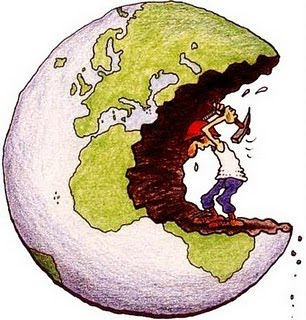
Illustration by Liana Buszka Text by Slavoj Zizek We should not simply oppose a principal life - dedicated to duty and enjoying our small pleasures.  Let's take today's capitalism. We have, on the one hand, the demands of the circulation of the capital which push us towards profit making - expansion, exploitation and destruction of nature and, on the other hand, ecological demands: let's think about our posterity and about our own survival, - let's take care of nature and so on.  In this opposition between ruthless pursuit of capitalist expansion and ecological awareness - duty, a strange perverted duty of course - duty is on the side of capitalism, as many perspicuous analysts noted. Capitalism has a strange religious structure. It is propelled by this absolute demand: capital has to circulate, to reproduce itself, to expand - to multiply itself. And for this goal, anything can be sacrificed, up to our lives, up to nature and so on. Here we have ...
Questioning the “exploitation of natural resources”

Image
Text translated by Louise Nicolas-Sourdot Texte traduit par Louise Nicolas-Sourdot A few weeks ago, I started working on an analysis of French secondary school textbooks and how they portray the relationship between humans and nature. Particularly, I examined an Earth and Life Sciences textbook for 6 th grade, and I obtained rather surprising results that I'm sharing with you in this post. In this textbook, the relationships between humans and nature are a rather secondary subject. Nonetheless, when these relationships are addressed, it is through the idea of the “exploitation of natural resources”. Apparently, one of the main learning objectives for the Earth and Life Sciences program in French secondary school is the understanding of the “impacts of the exploitation of natural resources”. What I would like to illustrate in this text is that this notion is far from being neutral, it symbolizes a strictly utilitarian and objectifying vision of nature, that i...

Language and the composition of social reality

By Rodrigo Cáceres In previous essays, we have been talking about the close relationships between language, frames, meaning, ethical values and social reality (you can take a look here for definitions). If we think about it, these discussions tend to change our traditional idea about what language is.  Generally, we think that language is a passive instrument, that allows us to "describe" a preexisting reality or to "express" our subjective experiences. In general, we think that language allows us to talk "about" things.  Conversely, we have been saying that language is an active and generative system, that language creates social reality. The linguist Michael Halliday (2007) would say that language is a semogenic system, in other words, it is a system that creates meaning.  As an example, we have seen how  talking about nature as a child generates a set of meaningful practices of respect, protection and caretaking of nature; as well as we...

Framing for care and engagement (Part IV): Nature is kin

Image
Photo by  Annie Spratt  on  Unsplash By Rodrigo Cáceres I n Part III of this post, we talked about strategies for undermining, discrediting and abandoning the frame of "Nature is a collection of resources" due to its intrinsic antagonism with a respect and appreciation for life on Earth. We also discovered an alternative frame: "Nature is our child", performed by a local community in India. This frame evokes nature in loving, protecting and caring terms. It also conceives a reciprocal, respectful and enduring relationship with nature, in a subject to subject exchange, highlighting nature's vitality, agency and its striving for existence. Another alternative frame that you may be familiar with is "Nature is our mother" that is used commonly through the notions of  Pachamama, Ñuke Mapu,   Mother Earth or Mother Nature. This frame is embodied by several indigenous cultures in Latin America (for example, Quechua, Mapuche, Aymara); a...

Framing for care and engagement (Part III): Nature is not a resource

Image
Photo by  Boris Smokrovic  on  Unsplash By Rodrigo Cáceres In Part II of this post , we talked about what frames are and their defining characteristics. We discussed specifically the frame "Nature is a collection of resources" and its political consequences in terms of objectifying living beings and in terms of giving meaning to concrete destructive practices of "resource extraction". In sum, we could conclude that this frame is antagonistic with a respect and appreciation of Life on Earth.  So, what should we do about this frame? Well, the obvious answer is that it should stop being employed. However, since it is a frame that is ingrained in modern cultures, this fight must be led at least at two different levels. The first level is (i)  undermining the frame ,   and it is precisely what we are doing in these essays. Namely, we are putting in perspective that the frame "Nature is a collection of resources" is not the definitive paradigm...

Framing for care and engagement (Part II): What is a frame?

Image
A lilac-breasted roller ( Coracias caudatus ). P hoto by  Sander Wehkamp  on  Unsplash By Rodrigo Cáceres In the first part of this post , we talked about the recent international consensus from governments and expert scientists ( i.e.  IPBES) stating that  "current trajectories" (including  "economic, social, political and technological factors" )  are incapable of coexisting in harmony with  life on Earth. We were also able to reveal potentially transformative narratives such as  "Reconciling with life " or  "Reconciling with nature " , that embody an active and loving engagement towards the defense of life on Earth. The main point that I've been trying to make in these essays is that the way we talk about  life on Earth  deeply matters and that there are profound differences between distinct ways of speaking about  life on Earth . Naturally, this is not just something that I claim on my own; it is one of t...

Framing for care and engagement (Part I): Defending life on Earth

Image
A lilac-breasted roller ( Coracias caudatus ). Photo by Sander Wehkamp on Unsplash By Rodrigo Cáceres In the  previous part of this post , we examined the word biodiversity as a highly abstract new word that we can quite hardly relate to our subjective and collective experiences of nature. Instead, the more intimate and inclusive words of " life"  and " life on Earth" show every sign of being profoundly adequate to trigger a deep engagement and care for life on Earth and a willingness to defend it from current destruction. For this reason, we will try to examine them a bit more deeply in this post. Before we start, for the purposes of this post I will assume that nature, biodiversity and life on Earth  are completely equivalent and interchangeable terms, since all three refer to the very same thing. I agree that there are some conceptual differences between the three terms because of their history ( for example, that in modern cultures nature...

Framing for apathy and disengagement: The "biodiversity erosion"

Image
Photo by Corrado Alisonno , licensed under   CC BY-NC-SA 2.0 One of the main purposes of environmental organizations, environmental journalism and conservation science is to get people to care about nature. People should care about nature because nature is beautiful, glorious and magnificent; because nature should be respected; because nature is being destroyed; because we cannot live without nature; because we are inseparable from nature, among many other reasons. Before we start, I want you to keep in mind this quote from Aldo Leopold, who is usually recognized as one of the most important environmental philosophers of the past century.  In one of his books from 1949, he stated that: “We can only be ethical in relation to something we can see, understand, feel, love, or otherwise have faith in.” Today I would like to bring your attention to one of the key concepts present in current environmental discourse: Biodiversity .   Biodiversity is a new word t...

No one to blame? Ways of erasing those responsible for environmental issues (Part II)

Image
By Rodrigo Cáceres In a previous post ,  we talked about the passivization of sentences as a form of eliminating grammatical agency. In simple words, this means reformulating a sentence so that the subject that carries out the action in a sentence disappears. And then we talked about how this has consequences for present-day environmental discourse and text. Today I want to introduce you to another possible form of eliminating agency, which is nominalisation. Nominalisation is simply the transformation of a verb into a noun, and it is widely used in day-to-day language.  To give you an example, let's take the verb pollute. In a typical formulation, one would say "X pollutes Y". In this case, "X" is the agent who is responsible for carrying out the action, the polluting. However, one can transform the verb pollute into the noun pollution (thus, a nominalisation). Using the noun pollution in a typical phrase would be something like "Pollution affe...

No one to blame? Ways of erasing those responsible for environmental issues (Part I)

Image
By Rodrigo Cáceres In the English language (also in French and Spanish) there are several ways in which one can suppress grammatical agency . W ithin a sentence,   grammatical agency refers to the presence of the subject that carries out the action of the verb. For example: "She broke the glass" ⇒ "The glass broke" In the left sentence, one can identify the subject "She" who carries out the action. However, one of the ways in which we can suppress the subject is through the  passivization of a sentence. So, in the sentence to the right, the subject was effectively erased. In it, we might infer that one of two things happened: whether  "somehow"  the glass was broken  or "somebody" must have broken the glass. However, we cannot know which of those happened. Therefore, whatever or whoever is responsible for the act has disappeared. To make things really concrete, let's take a look at a statement from the IPBES (Intergo...